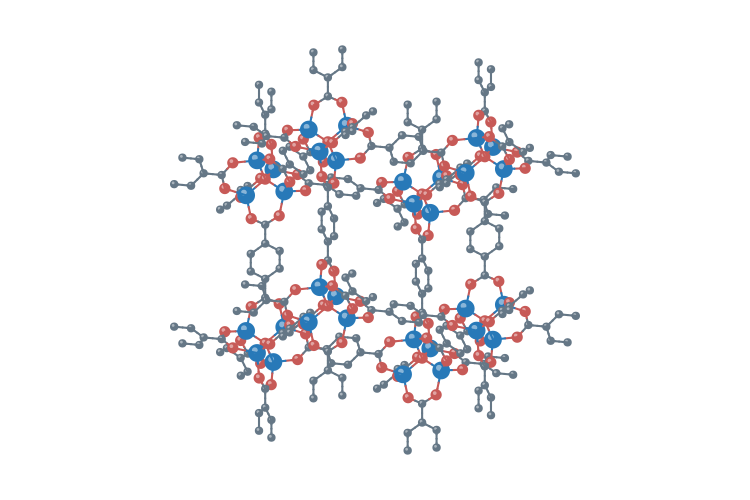
Engineering application domains · 공학 응용 분야
Our modeling, data, and AI methods are developed around concrete engineering problems.
We develop end-to-end computational frameworks that integrate quantum and atomistic simulations, statistical mechanics, curated data, and artificial intelligence. These frameworks connect quantum and atomistic information to material properties, process performance, and system-level outcomes for the energy, environment, and industrial applications.
양자·원자 시뮬레이션, 통계역학, 정제된 데이터와 인공지능을 통합하는 end-to-end 계산 프레임워크를 개발합니다. 이 프레임워크는 양자·원자 수준의 정보를 소재 물성, 공정 성능 및 시스템 수준의 성과로 연결하여 에너지·환경·산업 분야의 응용에 활용합니다.
Our modeling, data, and AI methods are developed around concrete engineering problems.
Materials classes that connect our fundamental and application-driven research.
양자·원자 수준 모델링
Quantum calculations, Monte Carlo methods, molecular dynamics, and enhanced sampling for molecular-scale structure, energetics, diffusion, reaction, and electrochemical behavior.
흡착·확산·반응의 기초
Molecular-level theories and simulations of adsorption thermodynamics, molecular diffusion, and reaction mechanisms in porous and condensed materials.
순환식 스윙 흡착
End-to-end models connecting adsorption and transport to pressure-, vacuum-, and temperature-swing cycle performance and techno-economic outcomes.
데이터 기반 자율 발견
Curated materials data, machine-learning models, and high-throughput screening for reproducible materials discovery.
AI 과학자와 계산 연구 자동화
LLM orchestration and tool-using agents that plan, execute, verify, and refine computational research workflows.
{{ yg.year }}
{{ item.month }}
{{ pg.year }}
{{ p.journal }}